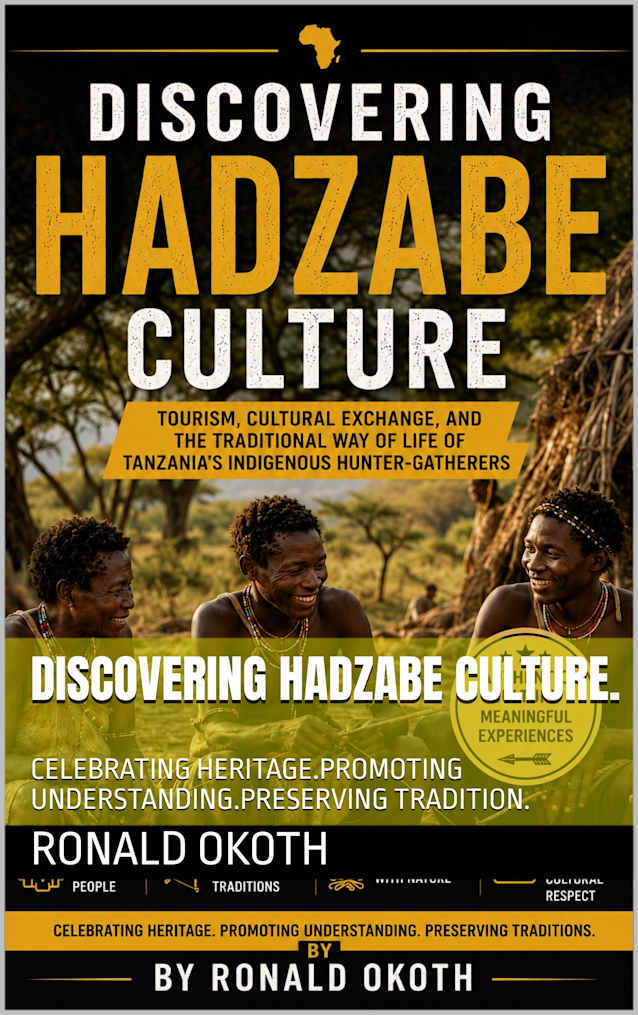
DISCOVERING HADZABE CULTURE.: CELEBRATING HERITAGE.PROMOTING UNDERSTANDING.PRESERVING TRADITION. (Wildlife Wonders of East Africa Safari Adventures Through the Land of the Big Five Book 8)
About
DISCOVERING HADZABE CULTURE
By Ronald Okoth
DISCOVERING HADZABE CULTURE: Tourism, Cultural Exchange, and the Traditional Way of Life of Tanzania’s Indigenous Hunter-Gatherers explores the unique lifestyle, traditions, and cultural heritage of the Hadzabe people of northern Tanzania. The book presents the Hadzabe as one of the last remaining hunter-gatherer communities in Africa, living mainly around Lake Eyasi and maintaining survival methods that closely resemble ancient human lifestyles.
The book explains how the Hadzabe survive through hunting wild animals and gathering fruits, roots, berries, and honey from the natural environment. It highlights their deep connection with nature, their nomadic lifestyle, and their remarkable survival skills developed over thousands of years. The Hadzabe use handmade bows, poisoned arrows, traditional fire-making methods, and detailed environmental knowledge to survive in forests and grasslands.
A major focus of the book is the importance of cooperation within Hadzabe society. Men traditionally hunt while women gather edible plants and care for families, creating a balanced social structure built on sharing, equality, and teamwork. The community values simplicity over material wealth, and food is shared among all members to ensure survival and unity.
The author also explores Hadzabe language, storytelling, music, dance, spiritual beliefs, and traditional clothing. Their oral traditions preserve history, survival knowledge, and cultural identity through songs, stories, and evening gatherings around the fire. The Hadzabe worldview is deeply spiritual and closely connected to nature, animals, weather, and ancestral traditions.
Another important theme is cultural exchange tourism. The book describes how visitors from around the world travel to Hadzabe communities to learn about indigenous African traditions, participate in hunting and gathering activities, observe dances and storytelling, and understand ancient survival techniques. Responsible tourism is presented as a way to preserve Hadzabe culture while creating economic opportunities for the community.
At the same time, the book discusses the challenges facing the Hadzabe today, including modernization, climate change, land conflicts, farming expansion, and tourism pressure. These changes threaten traditional hunting grounds, language preservation, and cultural identity. The author emphasizes the importance of protecting indigenous knowledge, environmental conservation, and cultural heritage for future generations.
Overall, the book is both an educational and cultural exploration of one of the world’s oldest surviving lifestyles. It teaches readers about sustainability, human resilience, environmental respect, and the value of preserving indigenous cultures in a rapidly changing modern world.